
Ants
Pavement ants: identification & pavement ant control
Pavement ants nest under concrete and enter through expansion joints and slab cracks. We bait the trails, treat the slab perimeter and seal the entry points so foraging stops at the door.
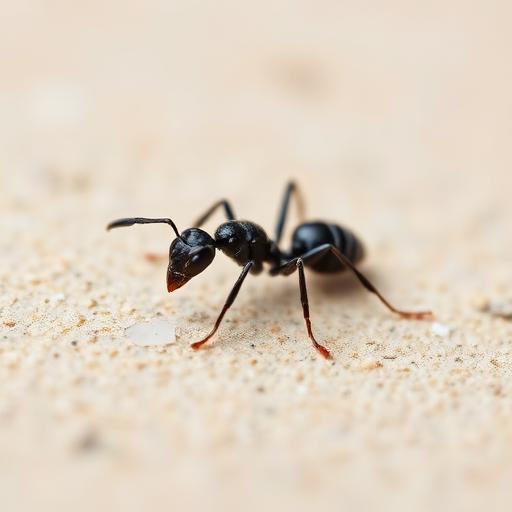
How to identify pavement ants
- What it looks like
- Dark brown-black ants with pale legs and fine parallel grooves on the head and thorax.
- Size
- 1/8 inch
- Where you'll find it
- Under sidewalks, driveways, patios, slab foundations and stones.
- Commonly confused with
- Odorous house ants lack head grooves and smell when crushed.
Signs of pavement ants in your home
- Small sand piles in sidewalk cracks
- Trails along garage walls
- Ant-versus-ant sidewalk battles in spring
Is it really pavement ants? Side-by-side comparisons
Pavement ants have distinct parallel grooves on the head and thorax; odorous house ants lack these grooves and emit a pungent, rotten coconut-like odor when crushed.
Pavement ants are dark brown-black with pale legs and antennae; little black ants (Monomorium minimum) are uniformly glossy black and smaller, around 1/16 inch.
Argentine ants (Linepithema humile) are uniform dull brown and lack the distinct head/thorax grooves of pavement ants. They also do not have a sting, which pavement ants possess.
Thief ants (Solenopsis molesta) are minute (1/32-1/16 inch), yellowish to light brown, with two-segmented antennal clubs, unlike the 12-segmented antennae of pavement ants.
Regional differences across the U.S.
Pavement ants, Tetramorium immigrans (formerly T. caespitum), are widespread across the continental US, but their presence and pest status vary. In the Northeast and Midwest, they are a primary urban nuisance pest, especially in states like New York, Pennsylvania, and Ohio, where freeze-thaw cycles contribute to concrete cracks, creating ideal nesting sites under sidewalks and foundations. In the Pacific Northwest, particularly Oregon and Washington, their activity peaks in late spring through summer, often invading homes during warmer, drier periods. In drier Western states like California and Arizona, they may forage more actively after irrigation or rain events, utilizing transient moisture sources. Southern states like Florida and Texas experience activity year-round, with increased indoor foraging during periods of heavy rain or extreme heat driving them indoors.
Life cycle and timing that changes treatment
Pavement ant queens lay eggs from spring through fall, developing through larval and pupal stages to adults in 6-8 weeks. Colonies produce one to two generations annually. Swarming (reproduction) typically occurs in late spring to early summer, often after rain. Workers and queens overwinter within their protected nests under pavement or structures, becoming active again as temperatures rise in spring.
How to inspect for pavement ants, step by step
- 1
Look along exterior concrete slabs, driveways, and sidewalks for small piles of excavated soil, especially near expansion joints or cracks, indicating subterranean nests.
- 2
Inside, use a flashlight at a low angle to inspect along baseboards, under sinks, and near heating ducts, checking for foraging trails or small clusters of ants.
- 3
Inspect outdoor potted plants and landscape timbers that directly contact the house foundation, as these can serve as bridge points for indoor entry.
- 4
Carefully lift patio stones, bricks, or decorative landscape elements in the yard; pavement ants frequently nest directly underneath these objects.
Treatment decision tree
| If you find this | Do this next |
|---|---|
| You observe occasional individual ants foraging indoors near a door or window. | This indicates exploratory foraging; check the immediate exterior for entry points and seal small cracks with caulk. Clean up any food crumbs. |
| You see a distinct trail of ants consistently entering the structure at a single point. | This suggests an established trail from an outdoor nest. Follow the trail to locate the nest entrance and consider an exterior perimeter bait or dust application. |
| Numerous ants are found consistently in a specific indoor area, like a kitchen or pantry. | This signifies a strong foraging presence, likely from a nest very close to or within the structure. Focus on indoor baiting and extensive sealing of entry points. |
| You notice small piles of soil or sand appearing from cracks in your basement floor or walls. | This strongly indicates a nest under the slab or within wall voids. This situation often requires more persistent baiting or targeted dust applications into the voids. |
| You observe a swarm of winged ants (reproductives) emerging inside your home. | This is a strong indicator of a mature, well-established colony nesting within the structure, demanding immediate and comprehensive professional assessment and treatment. |
Where DIY runs out of road
- • Over-the-counter repellent sprays often scatter colonies, making them harder to control as they split into multiple nests, a phenomenon called 'budding' or 'satteliting'.
- • Broadcast spraying of insecticides on lawns will not effectively eliminate pavement ant nests, which are deep under hard surfaces, leading to wasted product and unnecessary environmental exposure.
- • Inadequate baiting with insufficient or unpalatable baits can lead to 'bait shyness' where ants learn to avoid the bait, making future control efforts more challenging.
When to call a professional
- • Persistent indoor ant activity despite consistent DIY baiting and sealing attempts.
- • Discovery of nests under slab foundations, requiring specialized equipment or products.
- • Swarmers emerging indoors, indicating a well-established, inaccessible indoor colony.
Safety and legal limits
Always read and follow pesticide product labels precisely; the label is a legal document. Misuse can be harmful and ineffective. When applying insecticides, ensure adequate ventilation and wear appropriate personal protective equipment, such as gloves and eye protection, to minimize exposure. Keep children and pets away from treated areas until products have dried or settled, typically several hours. Never apply pesticides to surfaces where food is prepared or stored, or where contact with drinking water is possible. Avoid using broad-spectrum insecticides when targeted baiting can achieve control, as broad applications can harm non-target insects and beneficial organisms. Improper disposal of pesticide containers is illegal and harmful to the environment; follow local guidelines for hazardous waste.
Pavement ants questions homeowners ask
What are those little dirt piles between sidewalk cracks?
Excavated soil from a pavement ant nest directly beneath the concrete.
Are pavement ants harmful?
They rarely bite and cause no structural damage, but they contaminate food and can nest under slabs by the thousands.
Pavement ant control by city
Local technicians handle pavement ants in every market below — pick your city for neighborhood coverage, seasonal notes and a free quote.
Related ants pests
Sources and further reading
Guidance on this page is compiled from EPA, CDC and land-grant university extension IPM publications, which are linked in the sources section. It is general information, not a diagnosis or a treatment recommendation for your property.
- Pest Notes: home and landscape pests — University of California Statewide IPM Program
- Pest control and pesticide fact sheets — National Pesticide Information Center (Oregon State University / EPA)
- Integrated Pest Management (IPM) principles — U.S. Environmental Protection Agency
- Safe pest control in and around the home — U.S. Environmental Protection Agency