
Wildlife
Skunks: identification & skunk removal
Skunks den under porches and sheds and dig cone-shaped holes in lawns hunting grubs. We remove the animal carefully, exclude the den with buried barriers and treat the grubs drawing them in.
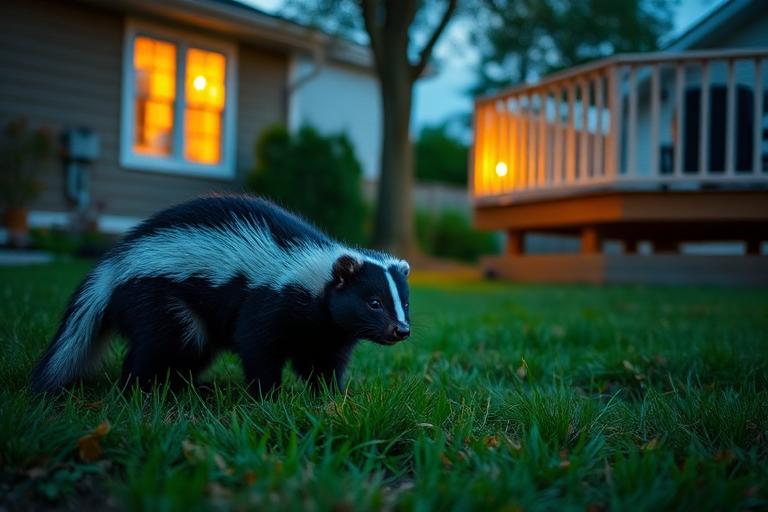
How to identify skunks
- What it looks like
- Black mammal with a bold white stripe or spots and a bushy tail.
- Size
- 6 to 10 pounds
- Where you'll find it
- Under porches, decks, sheds, crawl spaces and woodpiles.
Signs of skunks in your home
- Persistent musky odor
- Small cone-shaped diggings in the lawn
- Tracks with visible claw marks near a den
Regional differences across the U.S.
The striped skunk, *Mephitis mephitis*, is ubiquitous across the contiguous United States. In the Southeast, such as Florida and Georgia, skunks often forage year-round, while in colder northern states like Minnesota and Maine, they enter torpor during winter. This leads to seasonal differences in activity and denning. Construction in suburban areas, particularly homes with accessible crawl spaces, uncapped chimneys, or dense landscaping, provides ample denning opportunities. Arid regions, including Arizona and New Mexico, may see skunks more reliant on irrigated areas for water and food sources, concentrating their activity. Climate factors influence food availability, which in turn dictates skunk foraging patterns and den site selection.
Life cycle and timing that changes treatment
Skunks typically breed in late winter, from February to March, and give birth to litters of 4-7 kits in May or June. The young are weaned around two months old and often remain with their mother until late summer. Skunks have one litter per year. Their lifespan in the wild is generally 2-4 years. Control efforts are most effective before or during the breeding season to prevent establishment of dens with young, or in late summer when young disperse.
How to inspect for skunks, step by step
- 1
Identify active burrows or den sites: Look for holes approximately 4-6 inches in diameter, often under decks, sheds, or concrete slabs, indicated by fresh digging and a strong musky odor.
- 2
Examine property for entry points: Use a flashlight to check foundations, skirting, and vents for gaps, loose screens, or damaged sections larger than 3 inches that skunks could use.
- 3
Search for tracks and droppings: Skunk tracks show five toes with claw marks, and their scat, often found near den sites or feeding areas, contains insect fragments or seeds.
- 4
Assess food sources: Inspect garbage cans, pet food dishes left outdoors, bird feeders, and compost piles for signs of disturbance, as these attractants draw skunks to properties.
Treatment decision tree
| If you find this | Do this next |
|---|---|
| You notice an occasional skunk foraging in your yard at night without signs of denning. | Remove all external food sources (pet food, unsecured trash, fallen fruit) and consider motion-activated lights or sprinklers as deterrents to encourage them to move on. |
| You smell a persistent skunk odor around your property, but cannot locate a den. | Conduct a thorough inspection of potential den sites under structures, woodpiles, and dense vegetation during daylight hours. If confirmed, seal all but one entry and use a one-way exclusion door. |
| You observe a skunk repeatedly entering or exiting a specific location, confirming a den. | Implement a one-way exclusion device over the den entrance, ensuring no young are present inside (mid-summer to early fall is safest). Monitor for several nights to confirm exit. |
| You find evidence of a skunk den with young kits present (e.g., small tracks, squealing sounds). | Do not attempt exclusion until the young are mobile and can leave with the mother, typically late summer. Disrupting a den with dependent young often leads to abandonment and welfare issues. |
| A skunk appears disoriented, aggressive, or exhibits other signs of illness (e.g., foaming at the mouth, paralysis) during daylight hours. | Immediately contact your local animal control or wildlife authority. These behaviors can indicate rabies, a zoonotic disease, and require professional handling for public safety. |
Where DIY runs out of road
- • Over-the-counter repellents often provide limited or temporary relief, as skunks are primarily driven by food availability and denning needs, which these products do not address long-term.
- • Trapping skunks without proper training commonly results in being sprayed. Homeowners frequently misapply exclusion techniques, trapping skunks inside or separating mothers from their young.
- • Attempting to seal den entrances without ensuring the skunk has exited can trap the animal inside, leading to its death and subsequent odor problems, or cause it to create new entry points.
When to call a professional
- • If denning is confirmed under a primary structure like a home, especially if young are present.
- • When a skunk exhibits signs of illness or unusual aggression, indicating potential rabies.
- • For complex exclusion projects or when multiple skunks are consistently present on the property.
Safety and legal limits
Skunks are primary vectors for rabies in the United States; avoid all direct contact, especially with animals exhibiting atypical behavior like daytime activity or aggression. It is illegal in many states to trap and relocate skunks without a permit due to rabies transmission risks. Always wear appropriate personal protective equipment, including thick gloves, if handling any exclusion devices. When implementing exclusion, verify that no skunks are trapped inside, particularly young kits, as this violates animal welfare guidelines and can lead to severe odor issues upon their death. Follow all local and state wildlife regulations regarding nuisance wildlife removal and consult with authorities if unsure about legal parameters.
Skunks questions homeowners ask
Why is my lawn full of small holes?
Skunks dig 3 to 4 inch cone-shaped holes hunting grubs — treating grubs removes the food source.
Skunk removal by city
Local technicians handle skunks in every market below — pick your city for neighborhood coverage, seasonal notes and a free quote.
Related wildlife pests
Sources and further reading
Guidance on this page is compiled from EPA, CDC and land-grant university extension IPM publications, which are linked in the sources section. It is general information, not a diagnosis or a treatment recommendation for your property.
- Rabies and wild animals — U.S. Centers for Disease Control and Prevention
- Migratory Bird Treaty Act protected species list — U.S. Fish and Wildlife Service
- Integrated Pest Management (IPM) principles — U.S. Environmental Protection Agency
- Safe pest control in and around the home — U.S. Environmental Protection Agency