
Wildlife
Moles: identification & mole control
Moles tunnel for earthworms and grubs, lifting turf and roots as they go. Control uses trapping in active runways plus grub management where insects are drawing them in.

How to identify moles
- What it looks like
- Velvety gray-black body, no visible eyes or ears, and huge paddle-shaped front claws.
- Size
- 5 to 8 inches
- Where you'll find it
- Moist lawns, gardens, athletic fields and areas rich in earthworms.
- Commonly confused with
- Gophers leave fan-shaped mounds with a plugged hole; moles leave symmetrical volcano mounds.
Signs of moles in your home
- Raised ridges crossing the lawn
- Cone-shaped soil mounds
- Spongy turf that lifts underfoot
Is it really moles? Side-by-side comparisons
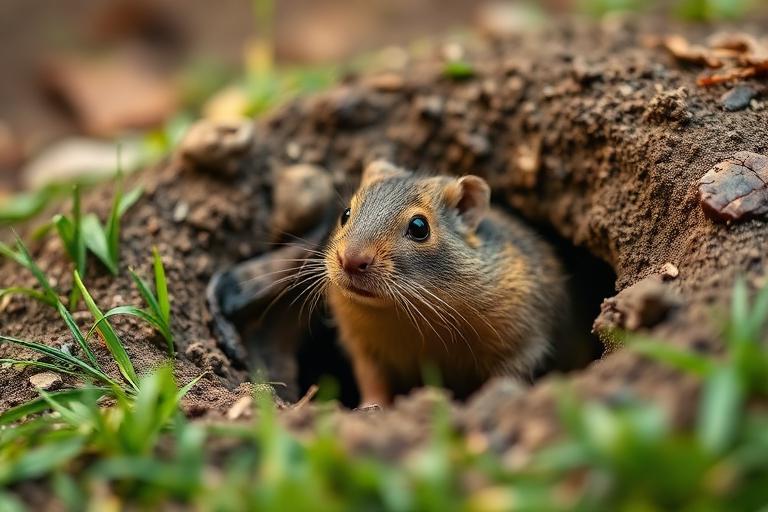
Mole mounds are symmetrical, circular, and volcano-shaped with a central plug. Gopher mounds are fan-shaped or crescent-shaped, with a distinct, off-center plugged hole.

Moles create extensive underground tunnels and visible surface runways with pushed-up soil. Voles create small, dime-sized surface entry holes and shallow, above-ground 'runways' in the grass.
Moles are subterranean, larger, and create distinct tunnel systems. Shrews are smaller, mostly surface dwellers, and do not create large, permanent burrows or mounds.

Mole activity is characterized by soil mounds and tunnels in lawns. Rat burrows are often near foundations or dense vegetation, with smaller, cleaner-edged entry holes and no pushed-up soil.
Regional differences across the U.S.
The Eastern Mole (Scalopus aquaticus) is prevalent across the eastern United States, from southern Canada to Florida, preferring well-drained soils. The Star-nosed Mole (Condylura cristata) occupies similar eastern regions but tolerates wetter, muckier soils, often near water sources. The Pacific Coast Mole (Scapanus californicus) is found along the West Coast, particularly in California and Oregon, thriving in a variety of soil types including sandy loams. The Broad-footed Mole (Scapanus latimanus) also inhabits California and extends into parts of Nevada and Mexico, favoring drier, often compacted soils. Western moles may exhibit less distinct seasonal activity due to milder winters, while Eastern moles show more pronounced surface tunneling in spring and fall. Regions with extensive irrigation, like California's agricultural valleys, can create perpetually favorable soil conditions, leading to higher mole densities.
Life cycle and timing that changes treatment
Moles typically have one litter per year, born in early spring (March-April), consisting of 2-5 young. Pups mature rapidly, dispersing by 5-6 weeks of age to establish their own territories. They reach sexual maturity at approximately 10 months. Moles do not truly hibernate but reduce activity and tunnel deeper during cold winter months, making fall and early spring crucial for control efforts before new litters are born.
How to inspect for moles, step by step
- 1
Look for fresh, symmetrical, volcano-shaped soil mounds in turfgrass, especially after rain or irrigation. Probe between mounds to locate active, shallow feeding tunnels.
- 2
Carefully flatten a section of a suspected active surface tunnel with your foot. Recheck 12-24 hours later; if it's pushed up again, the tunnel is active.
- 3
Examine garden beds for raised soil ridges and disturbed roots of plants, indicating moles tunneling for grubs and worms, often along structural edges.
- 4
Inspect the perimeter of lawns and gardens where they meet wooded areas or fences, as moles often initiate tunneling from these less disturbed zones.
Treatment decision tree
| If you find this | Do this next |
|---|---|
| You observe a single fresh mole mound in an isolated area of your lawn. | This indicates initial activity. Attempting to collapse the mound and monitoring for new activity is the first step before more intensive action. |
| You see several fresh mole mounds and raised tunnels appearing daily across a small section of your yard (e.g., a 100 sq ft area). | This suggests active foraging. Consider targeted trapping using scissor or choker traps in the most active tunnels to manage the population. |
| Multiple active tunnels and mounds are consistently appearing over a large area (e.g., 500 sq ft or more) for several days. | This indicates an established mole presence. Integrated pest management, combining trapping with cultural controls like reducing grubs, is advised. |
| Damage includes significant root disturbance to garden plants, extensive widespread tunneling, and persistent activity despite initial trapping attempts. | The mole population is likely larger or more persistent. Professional assessment and advanced control strategies like specialized baiting or extensive trapping grids may be necessary. |
| You have tried multiple DIY methods for several weeks without success, and the damage is impacting property aesthetics or plant health significantly. | DIY methods are proving ineffective. A licensed wildlife control professional possesses specialized tools and expertise for difficult-to-control mole infestations. |
Where DIY runs out of road
- • Over-the-counter granular repellents often contain castor oil, which may deter moles temporarily but rarely eliminates them, as moles quickly find new food sources or routes.
- • Smoke bombs or gas cartridges available to homeowners are generally ineffective. Moles quickly seal off affected tunnel sections, rendering the fumigant localized and ineffective against the entire tunnel system.
- • Vibrating stakes or ultrasonic devices do not reliably deter moles. Moles are highly adapted to their subterranean environment and typically ignore such disturbances, continuing their foraging activities.
When to call a professional
- • Extensive mole damage across large landscaped areas (e.g., athletic fields, golf courses).
- • Repeated mole activity in gardens or lawns despite consistent DIY trapping or baiting attempts.
- • Inability or unwillingness to handle trapping or baiting procedures involving lethal methods.
Safety and legal limits
Always read and strictly follow all product labels for any mole control product, as it is a legal document. Misuse can lead to ineffective control, environmental contamination, and harm to non-target animals or humans. Never use restricted-use pesticides unless you are a certified applicator. When using baits, ensure they are placed securely within active mole tunnels to prevent access by children, pets, and non-target wildlife. Wear appropriate personal protective equipment (PPE) as specified on the label, such as gloves, especially when handling baits or carcasses. Trapping should be done carefully to avoid injury to the user. Moles are not typically rabies vectors, but handling any wild animal always carries a risk of disease transmission or bites.
Moles questions homeowners ask
Do moles eat plant roots?
No — moles eat worms and insects, but their tunneling severs roots and voles often reuse the tunnels to eat plants.
Mole control by city
Local technicians handle moles in every market below — pick your city for neighborhood coverage, seasonal notes and a free quote.
Related wildlife pests
Sources and further reading
Guidance on this page is compiled from EPA, CDC and land-grant university extension IPM publications, which are linked in the sources section. It is general information, not a diagnosis or a treatment recommendation for your property.
- Rabies and wild animals — U.S. Centers for Disease Control and Prevention
- Migratory Bird Treaty Act protected species list — U.S. Fish and Wildlife Service
- Integrated Pest Management (IPM) principles — U.S. Environmental Protection Agency
- Safe pest control in and around the home — U.S. Environmental Protection Agency