
Wildlife
Armadillos: identification & armadillo control
Armadillos root through turf for grubs and dig burrows that undermine slabs and driveways. We trap the animal, collapse and exclude the burrow and treat the soil insects drawing them in.
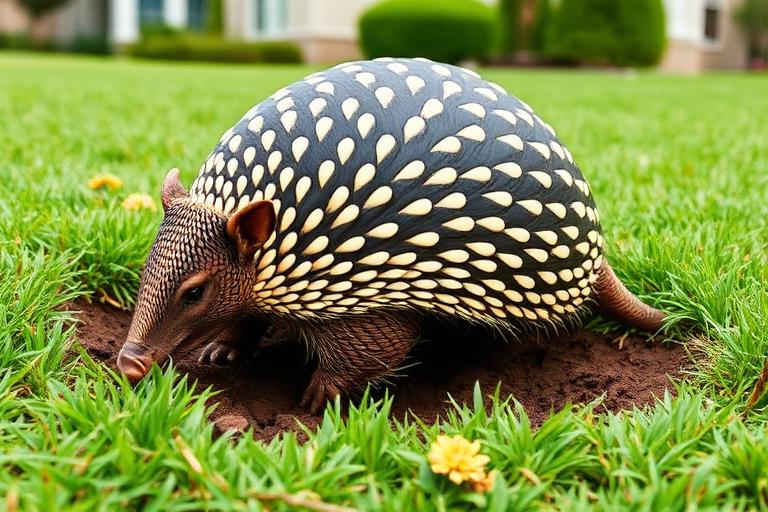
How to identify armadillos
- What it looks like
- Armored gray mammal with bony plates, a long snout and strong digging claws.
- Size
- 8 to 17 pounds
- Where you'll find it
- Burrows under sheds, decks, slabs and along brushy fence lines.
Signs of armadillos in your home
- Shallow 1 to 3 inch cone diggings across the lawn
- 7 to 10 inch burrow openings
- Uprooted mulch and flower beds
Regional differences across the U.S.
The nine-banded armadillo, Dasypus novemcinctus, is the primary species of concern in the US, having expanded its range significantly from the deep South. They are now common across Texas, Louisiana, Florida, and northward into states like Oklahoma, Arkansas, Mississippi, Alabama, Georgia, and even parts of Missouri, Kansas, and the Carolinas. Their northern expansion is limited by cold temperatures and frozen ground, which hinders their foraging for invertebrates. Warmer winters allow them to extend their range. In Texas, populations are well-established across all but the coldest panhandle regions. Florida's sandy soils provide excellent burrowing conditions. Construction factors like concrete slabs and foundations provide ideal locations for burrows.
Life cycle and timing that changes treatment
Armadillos typically live for 7-10 years. Breeding usually occurs from July to August, with a delayed implantation of the fertilized egg until November. Four identical offspring, all genetically identical and of the same sex, are born in March or April. They are weaned at around 2-4 months and reach sexual maturity at 1-2 years. There is only one litter per year, with no distinct generations, but activity levels are highest during warmer months.
How to inspect for armadillos, step by step
- 1
Look for burrow entrances, approximately 7-10 inches in diameter, under porches, decks, sheds, or concrete slabs. Use a flashlight to illuminate inside burrows, checking for activity.
- 2
Inspect along fence lines, especially in brushy or overgrown areas, for fresh digging or shallow holes, which indicate armadillo foraging activity for insects and grubs.
- 3
Examine lawns and garden beds for characteristic shallow, cone-shaped holes, typically 1-3 inches deep and wide, where they have dug for food items.
- 4
Check for disturbed soil or overturned sod near foundations or in flowerbeds, which can signal recent armadillo activity as they search for food or expand burrows.
Treatment decision tree
| If you find this | Do this next |
|---|---|
| You observe occasional foraging damage (shallow holes in lawn) but no structural burrowing. | This indicates transient armadillo activity. Focus on removing attractants like grubs with appropriate insecticides if desired, or allow natural predation. |
| You notice persistent foraging damage in your yard and suspect a resident armadillo. | Implement exclusion tactics such as fencing around vulnerable areas. Consider live trapping if permitted and relocate according to local regulations. |
| A small burrow is identified under a non-structural element like a small shed or dense shrubbery. | Confirm activity with flour or dirt in the entrance. If active, consider live trapping and exclusion methods, such as burying hardware cloth around the perimeter. |
| A large, active burrow is found under a porch, deck, or near a foundation. | This poses a potential structural risk. Attempting DIY removal without expertise can exacerbate the problem. Professional intervention is strongly advised due to potential structural damage. |
| Multiple large, active burrows are present under structural elements or threatening utility lines. | This is a severe infestation requiring immediate professional wildlife control. Structural integrity and safety are at risk, necessitating expert assessment and remediation. |
Where DIY runs out of road
- • Over-the-counter repellents for armadillos are generally ineffective, as armadillos are driven by foraging for insects, not just smell or taste aversions.
- • Live trapping without proper understanding of armadillo behavior and local regulations often results in no catch or catching non-target animals, wasting time and effort.
- • Attempting to fill in burrows without ensuring the animal is gone can trap the armadillo, causing it to dig out elsewhere, potentially creating new, more damaging burrows.
When to call a professional
- • Discovery of burrows directly under building foundations, concrete slabs, or utility lines.
- • Repeated armadillo activity despite diligent DIY exclusion and trapping attempts.
- • Uncertainty regarding local wildlife trapping and relocation regulations and best practices.
Safety and legal limits
Always adhere to all product label instructions when using any pest control chemicals; 'the label is the law.' For armadillos, direct chemical control is not standard or recommended. When live trapping, understand and comply with all state and local regulations regarding trapping and relocation of wildlife, as these vary significantly by jurisdiction. Armadillos can carry diseases such as leprosy (Hansen's disease), so avoid direct contact with live or dead animals. Use heavy gloves if handling is necessary. Ensure any exclusion or fencing methods do not pose a hazard to children, pets, or other non-target wildlife.
Armadillos questions homeowners ask
What is digging up my yard at night?
Scattered shallow cone-shaped holes with uprooted mulch usually point to armadillos or skunks hunting grubs.
Armadillo control by city
Local technicians handle armadillos in every market below — pick your city for neighborhood coverage, seasonal notes and a free quote.
Related wildlife pests
Sources and further reading
Guidance on this page is compiled from EPA, CDC and land-grant university extension IPM publications, which are linked in the sources section. It is general information, not a diagnosis or a treatment recommendation for your property.
- Rabies and wild animals — U.S. Centers for Disease Control and Prevention
- Migratory Bird Treaty Act protected species list — U.S. Fish and Wildlife Service
- Integrated Pest Management (IPM) principles — U.S. Environmental Protection Agency
- Safe pest control in and around the home — U.S. Environmental Protection Agency