
Stinging insects
Yellow jackets: identification & yellow jacket control
Yellow jackets nest in the ground, wall voids and attics and become aggressive in late summer. We treat the nest at the source in protective gear and seal the void so the colony cannot rebuild.
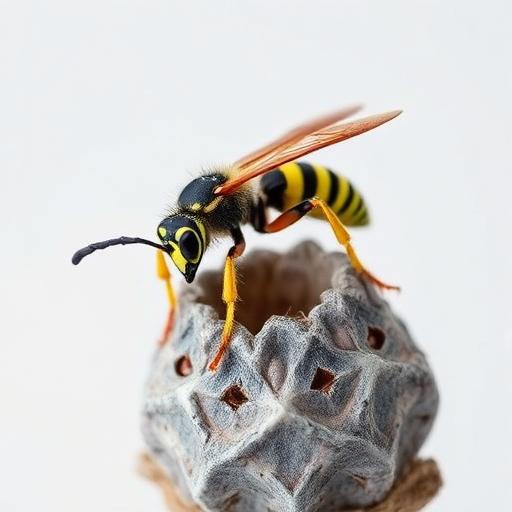
How to identify yellow jackets
- What it looks like
- Smooth, shiny black and bright yellow wasps with a narrow waist and quick, darting flight.
- Size
- 1/2 inch
- Where you'll find it
- Ground burrows, wall voids, attics, sheds, under siding and near trash.
- Commonly confused with
- Honey bees are fuzzy and golden; paper wasps have longer dangling legs in flight.
Signs of yellow jackets in your home
- Steady traffic into a hole in the ground or siding
- Wasps around soda, meat and trash
- Multiple stings when mowing
Is it really yellow jackets? Side-by-side comparisons
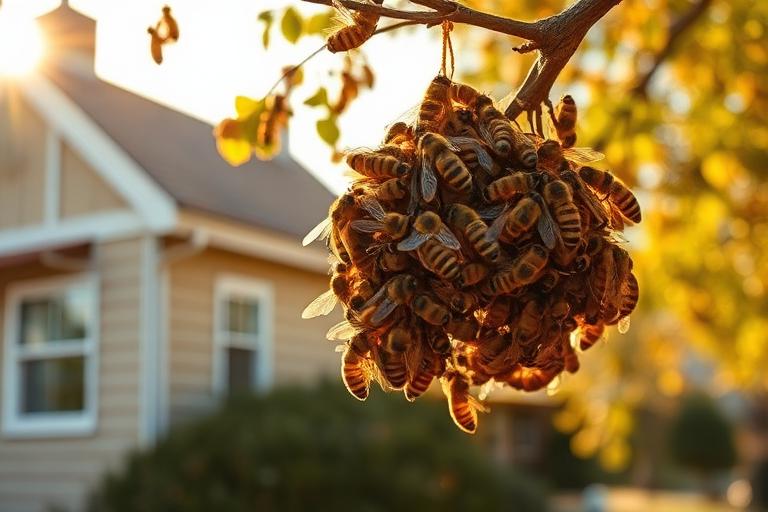
Honey bees (Apis mellifera) are noticeably fuzzy with a more robust, rounded body and typically golden-brown coloration; yellow jackets are smooth, shiny, and bright yellow/black.
Paper wasps (Polistes spp.) have longer legs that dangle conspicuously below their bodies during flight; yellow jackets hold their legs tucked in and have a quicker, darting flight.
Bald-faced hornets (Dolichovespula maculata) are predominantly black with distinct white or pale yellow markings on their head and thorax, not bright yellow and black.
European hornets (Vespa crabro) are significantly larger (up to 1.5 inches), with brown and yellow markings, and are generally more reddish-brown than bright yellow.
Regional differences across the U.S.
Yellow jackets are found throughout the United States, but species composition varies. The Eastern Yellowjacket (Vespula maculifrons) is prevalent east of the Rocky Mountains, often nesting in soil or rotten logs. The Western Yellowjacket (Vespula pensylvanica) dominates west of the Rockies, frequently nesting underground in abandoned rodent burrows. In the Pacific Northwest, the German Yellowjacket (Vespula germanica) is also common, known for nesting in wall voids and attics, especially in suburban areas with older homes offering ample void space. Peak activity and foraging pressure typically occur from late summer through fall across all regions as colonies reach their maximum size. Warmer climates, such as the Southeast and Southern California, can experience extended active seasons, potentially seeing earlier colony establishment in spring and later persistence into early winter if conditions remain mild.
Life cycle and timing that changes treatment
Yellow jacket colonies are annual. A single overwintering queen emerges in spring (typically April-May in temperate regions) to build a small nest and lay eggs. Larvae hatch, are fed by the queen, and develop into sterile female workers within 3-4 weeks. These workers expand the nest and forage, allowing the queen to focus solely on egg-laying. By late summer, the colony shifts to producing new queens and males. These mate, and the old queen, workers, and males die off with the first hard frosts, while new queens seek sheltered locations to overwinter.
How to inspect for yellow jackets, step by step
- 1
Carefully observe areas around potential nest sites like ground holes, wall cracks, or eave gaps for consistent, high-volume yellow jacket traffic during midday.
- 2
Use a flashlight and mirror to inspect enclosed, dark spaces such as attics, sheds, or crawl spaces for signs of nest construction or active yellow jacket presence.
- 3
During cooler morning or evening hours, cautiously check under siding, in outdoor grills, and near trash receptacles for foraging activity or nest entrances.
- 4
Listen for buzzing sounds emanating from wall voids, under decks, or within overgrown vegetation, indicating a hidden nest activity, especially when temperatures are mild.
Treatment decision tree
| If you find this | Do this next |
|---|---|
| You observe 1-2 yellow jackets foraging outdoors for short periods near human activity. | This indicates normal foraging; remove attractants like uncovered food and keep trash cans sealed to deter them. |
| You notice several yellow jackets consistently flying in and out of a small opening in the ground or a structure. | This strongly suggests an active nest. Observe from a safe distance to confirm the entry/exit point but do not disturb it. |
| You find a small, active yellow jacket nest (golf ball to baseball size) in an accessible, low-traffic outdoor area. | Consider using an approved aerosol wasp/hornet killer from a safe distance, following all label directions precisely, at dusk or dawn. |
| You encounter an active yellow jacket nest in a high-traffic area, indoors, or a large, established nest outdoors. | Do not attempt DIY removal. Clear the area of people and pets immediately and contact a pest management professional for assessment. |
| Multiple yellow jacket stings have occurred, or an individual with known insect sting allergies is present near an active nest. | This is a serious health risk. Immediately seek medical attention if needed and contact a professional pest control service for urgent intervention. |
Where DIY runs out of road
- • Over-the-counter wasp sprays are generally ineffective against large, established nests, particularly those within enclosed spaces like wall voids, due to limited penetration.
- • Attempting to block or seal a nest entrance without killing the colony can force yellow jackets into living spaces, creating a more severe indoor infestation and sting hazard.
- • DIY methods often fail to eliminate the queen, leading to rapid colony resurgence. Incomplete treatments can also make yellow jackets more aggressive, increasing sting risk.
When to call a professional
- • Nests are located in inaccessible areas like wall voids, attics, or high up on structures, posing a fall risk.
- • Multiple active nests are present on the property, indicating a significant infestation beyond a single treatment.
- • Any individual on the property has a severe allergy to insect stings, necessitating professional, high-precision removal.
Safety and legal limits
Always read and strictly follow all pesticide label instructions, as the label is a legal document. Never use products in a manner inconsistent with their labeling. Some professional-grade products, particularly those with active ingredients like fipronil or indoxacarb, are restricted-use and require a licensed applicator. When treating, ensure pets, children, and non-target wildlife are secured away from the treatment area and any drift. Consider respiratory protection, long sleeves, gloves, and eye protection. Avoid treating areas where active foraging by protected species, such as native pollinators, is observed. For indoor applications, ensure adequate ventilation to prevent inhalation exposure, and keep treated areas inaccessible until dry and aired out as specified by the product label.
Yellow jackets questions homeowners ask
Why are yellow jackets so aggressive in late summer?
Colonies peak in size and shift to sugar foraging, so they crowd around food and defend nests fiercely.
Yellow jacket control by city
Local technicians handle yellow jackets in every market below — pick your city for neighborhood coverage, seasonal notes and a free quote.
Related stinging insects pests
Sources and further reading
Guidance on this page is compiled from EPA, CDC and land-grant university extension IPM publications, which are linked in the sources section. It is general information, not a diagnosis or a treatment recommendation for your property.
- Honey bee health and pollinator protection — U.S. Department of Agriculture
- Pest Notes: home and landscape pests — University of California Statewide IPM Program
- Integrated Pest Management (IPM) principles — U.S. Environmental Protection Agency
- Safe pest control in and around the home — U.S. Environmental Protection Agency