
Flies & gnats
House flies: identification & house fly control
Flies breed in decaying organic matter, so control starts with finding the source — trash, drains, a dead animal or pet waste. We eliminate the breeding site and add baiting, traps and exterior treatment.
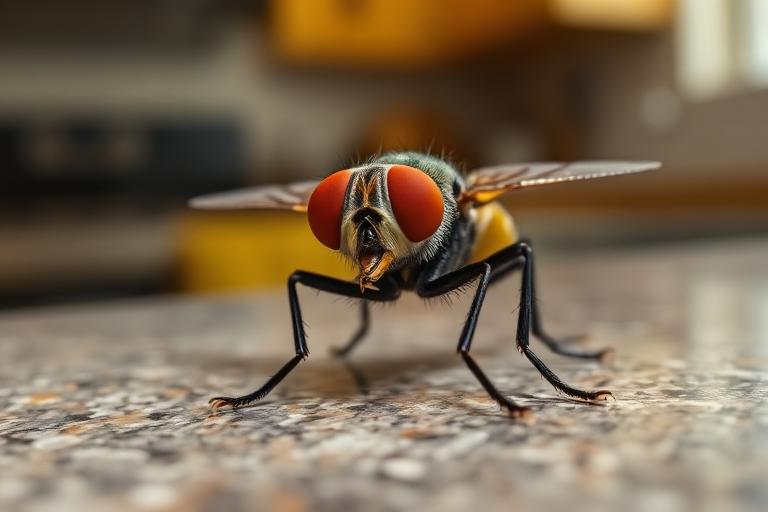
How to identify house flies
- What it looks like
- Gray flies with four dark stripes on the thorax and large red eyes.
- Size
- 1/4 inch
- Where you'll find it
- Kitchens, trash areas, dumpsters, compost, animal waste and drains.
- Commonly confused with
- Cluster flies are larger, sluggish and appear in fall; blow flies are metallic.
Signs of house flies in your home
- Flies clustering at windows
- Small dark specks on ceilings and light fixtures
- Maggots near trash or a dead animal
Is it really house flies? Side-by-side comparisons
Cluster flies are larger, slower-moving, have golden hairs on the thorax, and overwinter indoors, unlike house flies active in summer.
Blow flies, like the common green bottle fly (Lucilia sericata), possess a distinctive metallic blue or green sheen, whereas house flies are dull gray.
Stable flies are biting flies with a prominent, piercing proboscis protruding forward from the head, which house flies lack.
Female face flies have a broad silver-gray stripe between their red eyes, and they primarily bother livestock, rarely entering homes.
Regional differences across the U.S.
House flies (Musca domestica) are ubiquitous across all US states, but regional climate differences impact their seasonal activity and population density. In northern states like Minnesota or Maine, house fly activity is predominantly limited to warmer months from late spring through early autumn, with diapause or significant reductions in winter. In contrast, southern states such as Florida or Texas experience year-round activity due to consistently warm temperatures, leading to more generations per year and higher overall populations. Coastal regions and areas with high humidity, like the Gulf Coast, often see increased fly breeding in moist organic matter. Agricultural areas, particularly those with livestock operations in states like Iowa or Nebraska, face heightened risk due to abundant breeding sites. Urban environments across all regions present continuous risk due to human-generated waste and inadequate sanitation.
Life cycle and timing that changes treatment
House flies undergo complete metamorphosis: egg, larva (maggot), pupa, and adult. Under optimal conditions (around 80°F), the entire cycle from egg to adult can be completed in as little as 6-10 days, allowing for rapid population growth. Females lay hundreds of eggs in batches. Multiple generations occur annually, with up to 10-12 generations possible in warmer climates. Overwintering typically occurs as pupae or larvae in protected organic matter, though adults can survive in heated structures.
How to inspect for house flies, step by step
- 1
Check trash cans and dumpsters: Look for maggots or pupae in the moist, decaying organic matter at the bottom or sides of containers, using a flashlight.
- 2
Examine drains and garbage disposals: Inspect for a greasy film or organic build-up where larvae can develop, often requiring a flexible brush for observation.
- 3
Survey animal waste areas: Inspect pet waste, compost piles, or livestock manure for developing larvae or pupae, especially in sunny, moist locations.
- 4
Assess door and window integrity: Look for gaps, torn screens, or damaged weather stripping using a low-angle flashlight to identify potential entry points.
Treatment decision tree
| If you find this | Do this next |
|---|---|
| You observe 1-2 house flies indoors occasionally. | This indicates incidental entry. Improve exterior sanitation by securing trash lids and consider installing tighter-fitting door sweeps. |
| You see several house flies (3-5) indoors daily. | This suggests a nearby breeding source. Thoroughly inspect all potential breeding sites, especially trash, drains, and pet waste, and eliminate the source. |
| You consistently find 5-10+ house flies indoors. | A significant breeding source is likely nearby or inside. Intensify sanitation efforts, seal all entry points, and consider targeted non-chemical traps like sticky traps. |
| You observe maggots in indoor trash or organic matter. | An active breeding site is confirmed. Immediately remove the infested material, thoroughly clean and sanitize the area, and double-check waste management practices. |
| You have a constant, overwhelming presence of house flies despite rigorous sanitation and exclusion efforts. | This indicates a major, possibly external, breeding source or severe infestation. Professional pest control intervention is warranted for source identification and treatment. |
Where DIY runs out of road
- • Over-the-counter space sprays (aerosols) only kill adult flies present at the time of application and offer no residual control against emerging flies or larvae.
- • Simply swatting flies or using basic fly strips will not address the source of the infestation, leading to continuous reinfestation from undetected breeding sites.
- • Applying general insecticides around the home without identifying and eliminating breeding sources is often ineffective and can lead to unnecessary pesticide exposure.
When to call a professional
- • Persistent high fly numbers despite diligent sanitation and exclusion efforts.
- • Unidentified or inaccessible breeding sources that cannot be located or removed.
- • Presence of flies linked to significant structural or public health concerns.
Safety and legal limits
Always read and strictly follow the entire pesticide product label; it is a legal document. Misuse is illegal and can be harmful to humans, pets, and non-target organisms. Never use outdoor products indoors. Restricted-use pesticides can only be applied by licensed professionals. Ensure adequate ventilation when using any sprays. Keep children and pets away from treated areas until dry. When applying insecticides, consider drift to nearby plants or water bodies. Some non-chemical methods, such as fly traps, are generally safe, but placement should avoid accidental contact with children or pets. Proper sanitation is the safest and most effective long-term control method for house flies.
House flies questions homeowners ask
Why are there suddenly a lot of flies in my house?
A sudden indoor swarm usually means a breeding source inside — a dead rodent in a wall, a trash spill or a dirty drain.
House fly control by city
Local technicians handle house flies in every market below — pick your city for neighborhood coverage, seasonal notes and a free quote.
Related flies & gnats pests
Sources and further reading
Guidance on this page is compiled from EPA, CDC and land-grant university extension IPM publications, which are linked in the sources section. It is general information, not a diagnosis or a treatment recommendation for your property.
- Mosquitoes: control around the home and disease risk — U.S. Centers for Disease Control and Prevention
- Pest Notes: home and landscape pests — University of California Statewide IPM Program
- Integrated Pest Management (IPM) principles — U.S. Environmental Protection Agency
- Safe pest control in and around the home — U.S. Environmental Protection Agency