
Flies & gnats
Fruit flies: identification & fruit fly control
Also known as: vinegar flies
Fruit flies breed in fermenting residue — overripe produce, recycling bins, drains and mop buckets. Elimination means finding and cleaning every breeding film, then treating drains biologically.
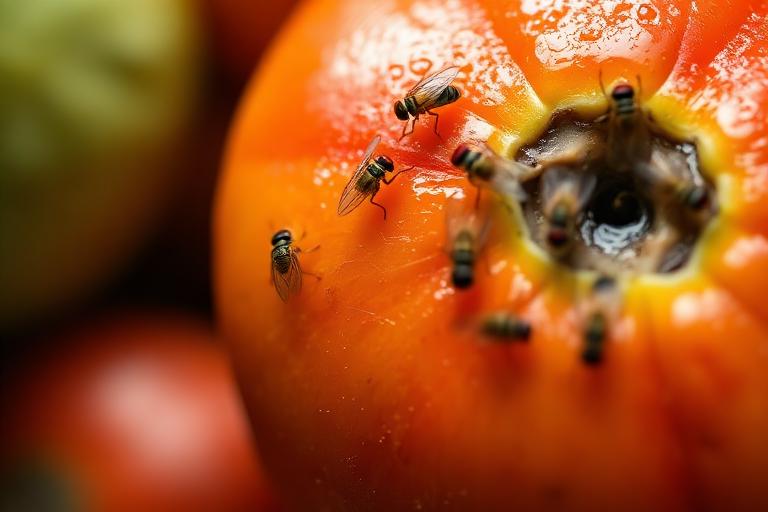
How to identify fruit flies
- What it looks like
- Small tan-brown flies, often with bright red eyes.
- Size
- 1/8 inch
- Where you'll find it
- Fruit bowls, trash and recycling, drains, beer and wine residue, mops and sink splash zones.
- Commonly confused with
- Fungus gnats are darker and near soil; drain flies are fuzzy and moth-like.
Signs of fruit flies in your home
- Flies hovering over produce
- Activity around the sink and recycling
- Flies rising from a drain when disturbed
Is it really fruit flies? Side-by-side comparisons
Fruit flies are typically tan to brown with characteristic bright red eyes, whereas fungus gnats are darker, almost black, with dull eyes and delicate, mosquito-like bodies.
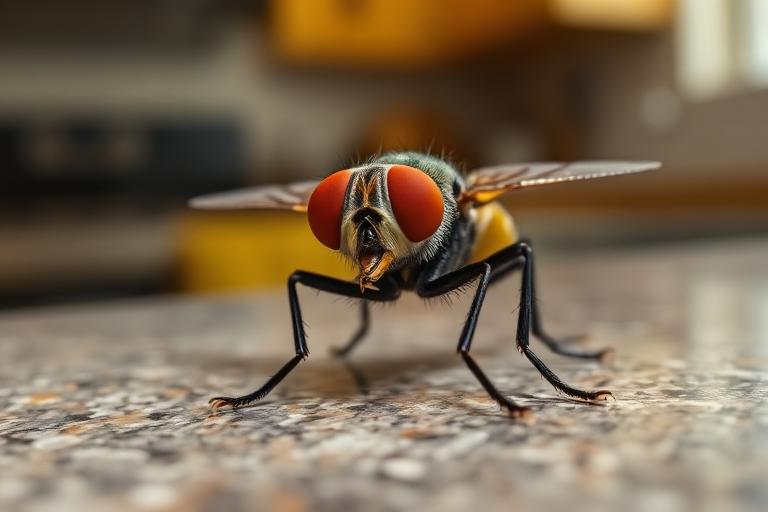
Fruit flies are smooth and agile fliers. Drain flies (*Psychoda* spp.) are noticeably fuzzy or hairy, with moth-like wings that hold a distinctive tent-like posture when at rest.
Fruit flies hover around food. Phorid flies, often called 'scuttle flies,' have a humped back and run erratically rather than flying when disturbed, especially in kitchens or bathrooms.
Fruit flies have clear wings and prominent red eyes. Sphaerocerid flies are usually dark brown or black, often with thicker legs, and prefer decaying organic matter, including animal waste.
Regional differences across the U.S.
The common fruit fly, *Drosophila melanogaster*, is ubiquitous across the contiguous United States, thriving wherever fermenting organic matter is present. However, other *Drosophila* species can dominate regionally. In the Pacific Northwest and New England, cooler summers can delay peak populations until late summer/early fall, while in warmer southern states like Florida and Texas, activity is more consistent year-round. Overwintering occurs as adults in sheltered indoor environments, or as pupae in milder climates. Humid regions, such as the Gulf Coast, increase risk due to faster mold and yeast growth on organic debris. Agricultural areas, particularly those with orchards or vineyards in California's Central Valley or New York's Finger Lakes, experience heightened seasonal pressure due to abundant food sources. Commercial fruit processing facilities nationwide also face elevated risk.
Life cycle and timing that changes treatment
Fruit flies undergo complete metamorphosis: egg, larva (maggot), pupa, and adult. The entire life cycle can be completed in as little as 8-10 days under optimal conditions (around 80°F), with egg-to-adult development taking roughly a week. This rapid development allows for multiple overlapping generations per year, making sustained control critical. Adults live for several weeks, continuously laying eggs, emphasizing source elimination for effective management.
How to inspect for fruit flies, step by step
- 1
Check under and around fruit bowls, ensuring no overripe produce or forgotten items are present. Use a flashlight to illuminate hidden spots.
- 2
Carefully inspect recycling bins for residues of sugary drinks, beer, or wine on cans and bottles, even if rinsed.
- 3
Examine drains in sinks, tubs, and showers. A low-angle flashlight can reveal flies or larvae near the opening or inside the pipe walls.
- 4
Look for moist, organic film buildup in mops, sponges, and dishcloths left near sinks, and behind or under kitchen appliances.
Treatment decision tree
| If you find this | Do this next |
|---|---|
| You observe 1-2 fruit flies hovering around a fruit bowl or open beverage container. | This indicates a localized food source. Immediately remove or refrigerate all produce and dispose of any fermenting items. Clean the area thoroughly. |
| You see several fruit flies (3-5) consistently in one area, like a kitchen counter or near a sink. | A persistent breeding source is likely present. Conduct a detailed inspection of all potential food and moisture sources within a 5-foot radius of sightings. |
| You notice fruit flies emerging from a drain or frequently congregating near a sink, even after removing food sources. | This suggests a breeding site within the drain itself. Apply a bio-enzymatic drain cleaner or thoroughly scrub the drain trap and overflow with a brush. |
| Dozens of fruit flies are present, seemingly throughout the kitchen or even adjacent rooms. | A significant, possibly multiple, breeding source(s) exists. This warrants a methodical, room-by-room search for all decaying organic matter, including forgotten spills or pet food. |
| Despite diligent sanitation and source removal efforts over several days, fruit fly populations remain high or increase. | An elusive or inaccessible breeding site is probable, or there's an ongoing re-infestation source. Professional pest control intervention is advisable for advanced inspection and treatment. |
Where DIY runs out of road
- • Over-the-counter insecticide sprays provide only temporary knockdown of adult fruit flies and do not eliminate the hidden larval breeding sites.
- • Simply pouring bleach down a drain is ineffective against fruit fly larvae and pupae within the organic film, potentially corroding pipes without solving the issue.
- • Homemade apple cider vinegar traps catch some adults but fail to address the root cause of infestation; without source removal, populations quickly rebound.
When to call a professional
- • When persistent infestations continue despite diligent sanitation and identification of obvious sources.
- • If fruit flies are emerging from inaccessible areas, such as behind walls, under floorboards, or from unknown pipe leaks.
- • For commercial establishments, especially those handling food, where stringent control and adherence to health codes are paramount.
Safety and legal limits
Always read and strictly follow the entire label directions for any pesticide product used. Misuse is a violation of federal law and can be dangerous to humans, pets, and the environment. Never apply restricted-use products unless certified and licensed. When using any pesticide, ensure proper ventilation, wear appropriate personal protective equipment like gloves and eye protection, and keep children and pets away from treated areas until dry. For fruit flies, non-pesticide methods like source removal and sanitation are highly effective and generally safer. If using an aerosol or residual spray, ensure it is specifically labeled for indoor use and fruit flies, and be aware of potential respiratory irritation or surface residue.
Fruit flies questions homeowners ask
How do I get rid of fruit flies fast?
Remove overripe produce, clean drains and recycling, and set vinegar traps — but the breeding film must be eliminated to stop the cycle.
Fruit fly control by city
Local technicians handle fruit flies in every market below — pick your city for neighborhood coverage, seasonal notes and a free quote.
Related flies & gnats pests
Sources and further reading
Guidance on this page is compiled from EPA, CDC and land-grant university extension IPM publications, which are linked in the sources section. It is general information, not a diagnosis or a treatment recommendation for your property.
- Mosquitoes: control around the home and disease risk — U.S. Centers for Disease Control and Prevention
- Pest Notes: home and landscape pests — University of California Statewide IPM Program
- Integrated Pest Management (IPM) principles — U.S. Environmental Protection Agency
- Safe pest control in and around the home — U.S. Environmental Protection Agency