
Flies & gnats
Cluster flies: identification & cluster fly control
Cluster flies overwinter inside walls and attics and reappear on warm days. Control is a timed exterior barrier treatment in late summer plus sealing of siding, soffit and window gaps.
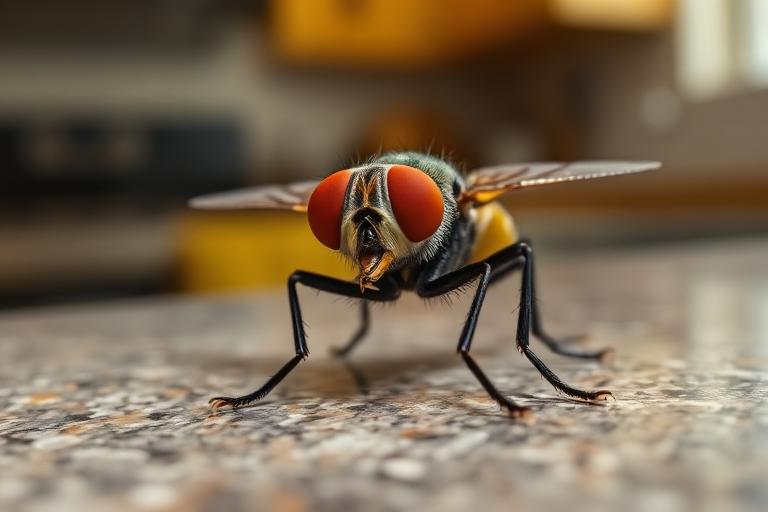
How to identify cluster flies
- What it looks like
- Slightly larger than house flies, dark gray with golden hairs on the thorax and overlapping wings at rest.
- Size
- 3/8 inch
- Where you'll find it
- Attics, wall voids, window frames and sunny south-facing walls in fall.
- Commonly confused with
- House flies are faster and present year-round near food.
Signs of cluster flies in your home
- Sluggish flies at windows on warm winter days
- Piles of dead flies in the attic
- Clusters on sunny exterior walls in fall
Is it really cluster flies? Side-by-side comparisons
Cluster flies are slower, have golden hairs on the thorax, and their wings overlap when at rest, unlike the parallel wings of house flies.
Cluster flies lack the metallic blue or green sheen typical of bottle flies; they are a dull, dark gray color with fine golden thoracic hairs.
While similar in size, face flies are typically found congregating around animal manure and are less likely to overwinter inside human dwellings in large numbers.
Stable flies possess a distinct piercing mouthpart (proboscis) that protrudes forward, enabling them to bite, a feature absent in cluster flies.
Regional differences across the U.S.
The common cluster fly, Pollenia rudis, is widespread across the United States, particularly in northern states and the Upper Midwest, including Wisconsin, Minnesota, and the New England region. In these areas, risk increases with older homes, especially those with undisturbed attics or wall voids. Further south, in states like Virginia or Missouri, a related species, Pollenia pediculata, may also be present. Seasonal timing for indoor invasions primarily occurs from late August through October as temperatures drop, with activity peaking on warm, sunny days. In regions with milder winters, such as the Pacific Northwest, cluster flies may become active indoors intermittently throughout the winter during warmer spells, while in colder climates, they remain dormant until early spring. Agricultural areas, particularly those with earthworm populations, experience higher cluster fly pressure.
Life cycle and timing that changes treatment
Cluster flies undergo complete metamorphosis: egg, larva, pupa, adult. Eggs are laid in soil and hatch in 3 days. Larvae are parasitic on earthworms, developing over 13-22 days. Pupation occurs in soil for 11-14 days. The entire egg-to-adult cycle typically takes 27-39 days. There can be 3-4 generations per year in temperate climates. Adults overwinter in protected structural voids of homes, emerging in spring.
How to inspect for cluster flies, step by step
- 1
Use a bright flashlight at a low angle to inspect window sills and frames, especially on upper floors and south-facing walls, for dormant or sluggish flies in fall and spring.
- 2
Carefully check undisturbed attic spaces, particularly around eaves and ridge vents, looking for accumulations of dead or sluggish flies and their fecal spots.
- 3
Examine wall voids from the interior by checking outlet and switch plate covers for evidence of fly activity or entry points, using a bore scope if accessible.
- 4
Inspect the exterior of the structure, focusing on south and west-facing walls, for potential entry points such as unsealed fascia boards, soffit vents, and gaps around utility penetrations.
Treatment decision tree
| If you find this | Do this next |
|---|---|
| You notice a few sluggish cluster flies indoors in late fall or early spring, primarily near windows. | This indicates overwintering adults emerging. Vacuum up visible flies. Focus on sealing exterior entry points before next fall. |
| You find dozens of cluster flies congregating on the sunny, exterior walls of your home in late summer or early fall. | This is a pre-overwintering congregation. Seal all exterior cracks and openings (1/8 inch or larger) in the next 1-2 weeks. |
| You observe significant numbers (hundreds) of live or dead cluster flies in an attic or wall void during inspection. | This indicates an active overwintering site. Consider a perimeter insecticide application to exterior walls in early fall, targeting entry points. |
| Flies are continuously emerging from wall voids or ceilings throughout winter, despite exterior sealing efforts. | This suggests deep harborage within inaccessible voids. Insecticide dusts applied into voids may be necessary for control. |
| You experience recurring, large-scale indoor infestations (thousands of flies) year after year. | This points to significant, unaddressed structural entry points and overwintering sites. A comprehensive professional inspection and treatment plan is warranted. |
Where DIY runs out of road
- • Over-the-counter space sprays offer only temporary knockdown of visible flies and do not address the source of the infestation within structural voids.
- • Indiscriminate application of residual insecticides around interior windows and walls can lead to unnecessary chemical exposure without controlling flies emerging from hidden harborage.
- • Attempting to seal exterior entry points after flies have already entered the structure will trap them inside, potentially worsening indoor activity throughout the winter and spring.
When to call a professional
- • Persistent, large-scale indoor activity (hundreds or thousands of flies) despite DIY efforts.
- • Infestations originating from inaccessible structural voids like attics, eaves, or wall cavities.
- • Need for targeted exterior treatments with professional-grade residual insecticides before overwintering begins.
Safety and legal limits
Always read and follow all pesticide label instructions precisely. The label is a legal document, and misuse can result in ineffective control, environmental contamination, or harm to humans and pets. Do not use outdoor-rated products indoors. When applying insecticides, especially dusts or aerosols into voids, ensure adequate ventilation. Keep children and pets away from treated areas until dry or as directed by the label. Certain professional-use insecticides are restricted-use products requiring a licensed applicator. For cluster flies, non-repellent pyrethroid-based or neonicotinoid-based insecticides are commonly used in targeted exterior applications. Avoid applying directly to blooming plants to protect pollinators.
Cluster flies questions homeowners ask
Why do flies appear in my house in winter?
Cluster flies overwintering in wall voids wake up on warm days and move toward light indoors.
Cluster fly control by city
Local technicians handle cluster flies in every market below — pick your city for neighborhood coverage, seasonal notes and a free quote.
Related flies & gnats pests
Sources and further reading
Guidance on this page is compiled from EPA, CDC and land-grant university extension IPM publications, which are linked in the sources section. It is general information, not a diagnosis or a treatment recommendation for your property.
- Mosquitoes: control around the home and disease risk — U.S. Centers for Disease Control and Prevention
- Pest Notes: home and landscape pests — University of California Statewide IPM Program
- Integrated Pest Management (IPM) principles — U.S. Environmental Protection Agency
- Safe pest control in and around the home — U.S. Environmental Protection Agency